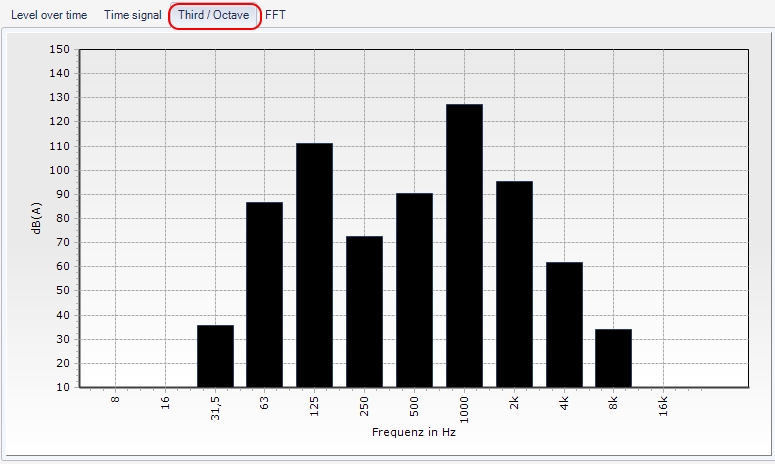
You can calculate and display an octave analysis from one of the microphone channels or the sum channel.
To do this, click the 'Third / Octave Analysis' tab.
No octave analysis can be displayed during the measurement.
After the measurement, the spectrum of the currently selected signal section is displayed (see Zoom).
Please note:
If you select the 'Enveloping surface sound pressure' for analysis, the correction terms are not taken into account.
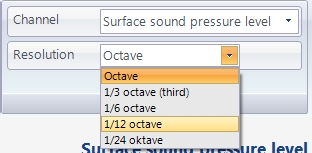
Setting the resolution or bandwidths in the 'Resolution' menu:
|
Band width |
Lower limit frequency of the filter (-3 dB), based on band center frequency |
Upper limit frequency of the filter (-3 dB), based on band center frequency |
|
Octaves |
0,7 |
1,4 |
|
1/3 Octaves (Thirds) |
0,89 |
1,12 |
|
1/6 Octaves |
0,952 |
1,051 |
|
1/12 Octaves |
0,976 |
1,025 |
|
1/24 Octaves |
0,988 |
1,012 |
The filter bands have constant relative band widths.
Please note that digital filters are similar to analog filters in many respects: the lower the bandwidth of a band pass, the longer its settling time. In the case of broadband excitation (switch-on klicks), a band pass resonates. The time until this oscillation subsides is inversely proportional to the bandwidth of the band pass. To reduce this effect of the oscillation excitation at the beginning of the input signal, the input signal is weighted before the calculation with a window function, which fades in the signal slowly. During this settling time, the result is inaccurate. The duration of this transient suppression is calculated dynamically.
As a point of reference, two examples of the duration of the suppression of the settling time:
|
Third analysis from 20 Hz to 20 kHz |
The bandwidth of the lowest filter is about 4.6 Hz. |
|
1/24 Octave analysis from 1 Hz to 20 kHz |
The bandwidth of the lowest filter is approximately 0.024 Hz. |
The results are accurate beginning after twice the time, i.e., in the two examples above, after 1.6 s and 274 s, respectively. Up to this time the results at low frequencies are inaccurate.
Band center frequencies for octaves and thirds are the nominal band center frequencies (rounded frequency values).
The frequency bands for the other resolutions (1/6 .. 1/24 octaves) are frequency bands to the base 10 (frequencies 1 Hz, 10 Hz, 100 Hz, ... are exactly included), see IEC 1260, DIN EN 61260.
12 bands with the following band center frequencies are calculated:
|
16 kHz |
250 Hz |
|
8 kHz |
125 Hz |
|
4 kHz |
63 Hz |
|
2 kHz |
31,5 Hz |
|
1 kHz |
16 Hz |
|
500 Hz |
8 Hz |
36 bands with the following band center frequencies are calculated:
|
20 kHz |
2 kHz |
200 Hz |
20 Hz |
|
16 kHz |
1,6 kHz |
160 Hz |
16 Hz |
|
12,5 kHz |
1,25 kHz |
125 Hz |
12,5 Hz |
|
10 kHz |
1000 Hz |
100 Hz |
10 Hz |
|
8 kHz |
800 Hz |
80 Hz |
|
|
6,3 kHz |
630 Hz |
63 Hz |
|
|
5 kHz |
500 Hz |
50 Hz |
|
|
4 kHz |
400 Hz |
40 Hz |
|
|
3,15 kHz |
315 Hz |
31,5 Hz |
|
|
2,5 kHz |
250 Hz |
25 Hz |
|
Bands with the following band center frequencies are calculated:
Band center frequency( i ) = 1000 * 10(( 40 - i ) / 20 )
Bands with the following band center frequencies are calculated:
Band center frequency( i ) = 1000 * 10(( 80 - i ) / 40 )
Bands with the following band center frequencies are calculated:
Band center frequency( i ) = 1000 * 10(( 160 - i ) / 80 )